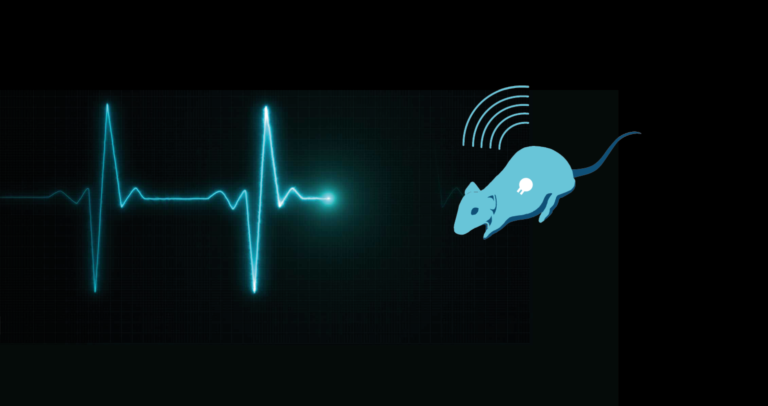




















easyTEL+ is a fully implantable digital system, that transmits physiological data from conscious freely moving laboratory animals.
Intended for use in preclinical research (primarily toxicology, pharmacology and safety pharmacology studies) and biodefense, the easyTEL+ implants are ideal for rodents > 200g such as rats.
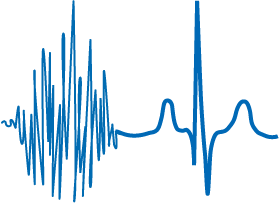
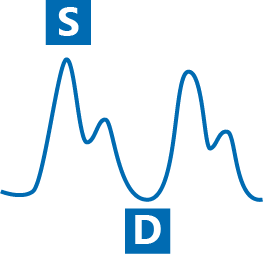
Various models offer the ability to continuously record Biopotential (ECG, EEG, EMG, EOG)*, Blood pressure (Arterial and/or Left Ventricular Pressure), Respiratory rate**, Temperature and Acceleration.
*Electrocardiogram (ECG), electroencephalogram (EEG), electromyogram (EMG),
electrooculogram (EOG)
**Derived from pleural or blood pressure or diaphragmatic EMG
| Model | Biopotential (E) | Pressure (P) | Temperature (T) | Activity (A) | Volume (cc) | Animal weight | M1-EETA | 2 | 1 | 1 | 8.8 | >200g |
|---|---|---|---|---|---|---|
| M1-EPTA | 1 | 1 | 1 | 1 | 8.8 | >200g |
| M1-PTA | 1 | 1 | 1 | 8.8 | >200g | |
| M1-ETA | 1 | 1 | 1 | 8.8 | >200g | |
| M1-TA | 1 | 1 | 5.5 | >100g |
Access the detailed specifications here.

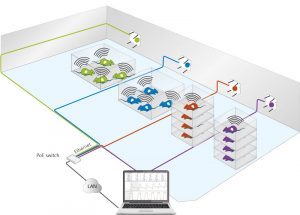
A standard setup features implants, receivers, an Ethernet switch, and an acquisition computer. A single Ethernet cable facilitates both power and data transmission between the receiver and the PC. Additionally, cameras can be integrated for synchronized video recording. For enhanced functionality, a Head-mounted system for rats can also be incorporated into the same setup.
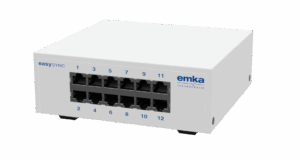
Adding an easySYNC device to the basic system allows to track and analyze the behavior, movement, and activity of an animal in Noldus EthoVision software while synchronizing physiological data from easyTEL+ telemetry system. Learn more.
Combining implantable telemetry with whole body plethysmography offers researchers a comprehensive understanding of the intricate mechanisms linking respiratory, cardiovascular, and neurological functions. The vivoFlow+ plethysmograph respiratory parameters can be acquired simultaneously with cardiovascular and neurological data from the easyTEL+ implants via the easyDAC box. All signals acquired by easyDAC are fully synchronized and simultaneously recorded in IOX2 software.

| Model | Biopotential (E) | Pressure (P) | Temperature (T) | Activity (A) | Volume (cc) | Battery life (days)* | Unipolar biop. | Bipolar biop. | Pressure catheter length (cm) | M1-EETA | 2 | 1 | 1 | 8.8 | 80 |
|---|---|---|---|---|---|---|---|---|---|
| M1-EPTA | 1 | 1 | 1 | 1 | 8.8 | 55 | 10 or 15 | ||
| M1-PTA | 1 | 1 | 1 | 8.8 | 95 | 10 or 15 | |||
| M1-ETA** | 1 | 1 | 1 | 8.8 | 75 | ||||
| M1-TA | 1 | 1 | 5.5 | 150 |
* Days of continuous recording, given for a standard configuration:
Single biopotential = ECG @ 500Hz, Multi-biopotential = EEG or EMG @ 250 Hz,
Any implant can be reconfigured by the user to be used for either ECG, EEG or EMG acquisition (this will impact the battery life).
** Includes a reference with expanded temperature range for hibernating animals.
“Monopolar”, “Unipolar” and “Common ground” are equivalent terms that can be found in the litterature.
easyTEL+ implants range offers various configurations:
Single lead biopotential, using a 2-wire electrode
To get 1 EEG, EOG, EMG or 1-lead ECG (Lead II placement is usually chosen (but not necessarily).
Dual biopotential
To get a 2-lead ECG or a combination of 2 biopotentials amongst 1-lead ECG, EEG, EOG or EMG.
Unipolar configuration, using 3 wires electrodes
In this configuration, the reference electrode is common to both biopotentials. Unipolar biopotential is easier for the surgery but both biopotentials must be similar (2 EEG or 2 ECG for instance).
Biop 1 = Electrode 1 – Electrode 2
Biop 2 = Electrode 3 – Electrode 2
Bipolar configuration, using 4 wires electrodes
In this configuration, the biopotential is measured between the positive and negative electrode, allowing to get two independent biopotentials (EEG and EMG for instance).
Biop 1 = Electrode 1- Electrode 2
Biop 2 = Electrode 3- Electrode 4
For ECG, lead III can be deduced by the software from leads I and II.
Implants are ETO processed and ready for implantation (to maintain treatment, the package should not be pierced).
However, as they can be used, explanted and reimplanted multiple times, this article give advice for disinfection and sterilization.
Cleaning and disinfection
After implantation for a long period of time, it is common to find the catheter, electrodes and implant body covered with connective tissue.
Be careful when using a scalpel to cut tissues from around or above the implant, as it could damage the electrodes, catheter or implant body.
To clean the transmitter, we recommend to immerse it in an enzymatic detergent such as Terg-A-Zyme®. Please follow the supplier instructions to make the solution, and soak the implant during 4 to 12 hours. Rinse the implant, preferably with running water.
In order to limit the spread of bacteria during handling, we recommend disinfecting the implant after its cleaning, using a 2.4% Glutaraldehyde solution (e.g. Actril or Cidex):
Implants should be immersed for a defined amount of time (in general 5 to 10 hours, please follow the supplier instructions) prior to use.
Rinsing / immersing in sterile saline before implantation is mandatory to fully remove the zing solution (up to 48 hours)
Aseptic technique should be used when performing this rinse procedure, using sterile container and gloves when handling the sterilized instruments and devices.
Please consult emka TECHNOLOGIES for any other alternative method.
Sterilization
Implants must be sterilized or disinfected before re-implantation. Most protocols accept a disinfection according to the above procedure. Where sterilization is required :
We recommend using ETO but at ambient pressure and temperature.
The Anprolene ETO sterilizer from Andersen works in these conditions and will not damage your implants.
CAUTION:
Inappropriate temperature/pressure/method may destroy your device!
DO NOT autoclave, exceed 40°C, use radiation sterilization, use dry or moist heat sterilization on emka telemetry implants.
Implant with pressure catheter: DO NOT apply vacuum below 600 mmHg (absolute value, or -160 mmHg under atmospheric pressure)
Consult emka TECHNOLOGIES for any other alternative method.
A major advantage of fully implantable systems is their compatibility with water-based tests (i.e. Morris Water Maze, Forced Swim Test).
With a transmission distance of 5 m between transmitter and receiver, easyTEL+ telemetry allows for uninterrupted behavioral observations concurrently with high resolution physiological recordings.
easyTEL+ telemetry allows group housing as well.
Transmitter state (on/sleep) and reconfigurable settings (sampling rate, resolution, transmission power, transmission frequency, etc.) can be controlled wirelessly. This reduces human interaction, thereby increasing the likelihood or the animal’s natural state during behavioral testing.
Furthermore, our partnership with Noldus Information Technology allows to offer a solution where digital telemetry and video tracking are integrated. Contact us to learn more!
It is completely normal to observe a small amount of blood, ranging from 0.25 to 1 mm in the tip of the catheter after explantation. However, during surgery, a gradual process of blood coagulation can sometimes occur. Often unnoticed, the development of a clot poses a hidden risk in the collection of accurate data. As days pass and the clot enlarges, the pressure signal amplitude diminishes, signaling potential complications. To ensure optimal outcomes and prevent clot formation, the following best practices are essential:
Quality of Signal (QoS) and Received Signal Strength Indicator (RSSI) are independent signals which may be recorded during an implanted telemetry acquisition. QoS and RSSI monitor changes in the radiofrequency environment between the implant and acquisition computer to qualitatively and quantitatively track signal quality. These signals have benefits both in acquisition and analysis. In acquisition, if signal quality is poor, it enables a user to take corrective action to improve the signal. During analysis QoS and RSSI can be automatically applied to prevent segments of signal drop from contributing inaccuracies to analysis results.